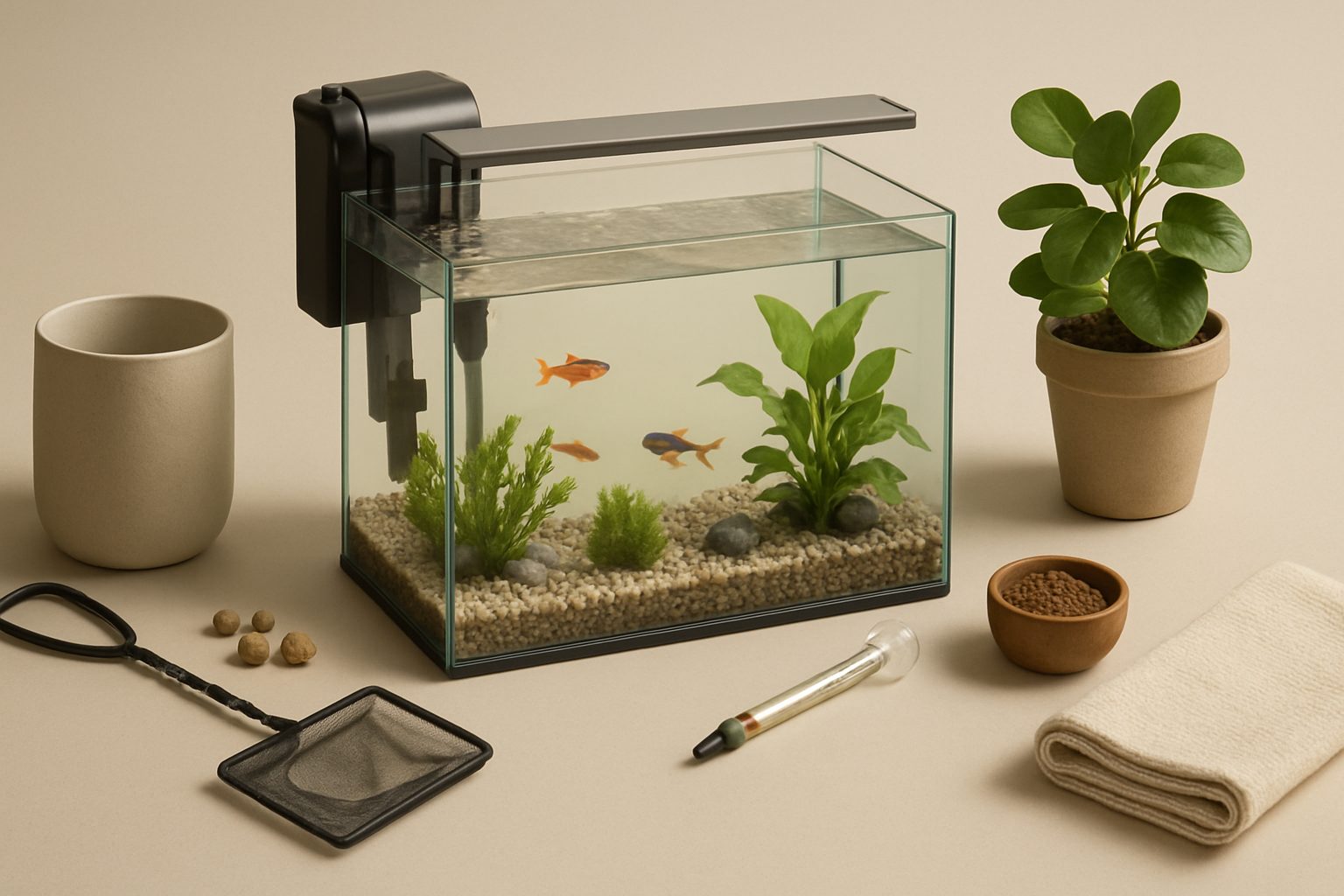
How to Set Up a Fish Tank for Beginners UK: Complete Step-by-Step Guide
Setting up your first aquarium is straightforward if you follow a logical sequence. Skip the wrong steps and you'll end up with cloudy water, dead fish, or algae blooms—common pitfalls that put beginners off the hobby. This guide walks you through what you actually need to do, in the right order.
Choose Your Tank Size
Bigger tanks are easier to maintain than small ones. A 60-litre tank (around 60 cm long) is the practical minimum for beginners because it buffers water chemistry better and gives you room to stock a variety of fish. Smaller tanks swing wildly in temperature and ammonia levels, making them unforgiving.
Standard UK dimensions like 60 × 30 × 30 cm work well. You'll find them readily available, and they're easy to fit on a sturdy stand. Avoid tanks narrower than 30 cm—fish need length more than height for swimming space.
Check your floor or furniture can support the weight. A filled 60-litre tank weighs around 60 kg, so it needs solid support, not a flimsy bookcase.
Add Your Substrate
Substrate is the material at the bottom of your tank. For planted tanks, choose aquarium soil (such as ADA Aquasoil or cheaper alternatives like Flourite). For fish-only tanks, inert gravel or sand works fine.
Avoid coloured gravels from garden centres or pet shops that claim to improve water quality—they often leach chemicals. Stick to plain gravel or specialist aquarium substrates. Use about 5–8 cm depth; deeper than this and pockets of decomposing waste create dead zones.
Rinse gravel thoroughly before adding it. Most gravel contains fine dust that turns water cloudy if you don't.
Install Your Filter
Filtration removes waste and creates surface agitation for oxygen exchange. You have three main options:
Internal filters are compact and cheap. They work fine for small tanks (up to about 40 litres) but produce weaker water flow.
External canisters sit under the cabinet and handle larger tanks well. They're more expensive upfront but quieter and easier to maintain.
Hang-on-back filters are a middle ground: affordable, reasonably quiet, and suitable for 40–100 litre tanks.
For a 60-litre tank, a canister filter or quality hang-on-back rated for 80–100 litres gives you flexibility for future expansion. The filter should turn over the tank volume four times an hour—so for 60 litres, aim for a flow rate around 240 litres per hour.
Fill the filter with media in layers: mechanical (sponge, floss) at the intake, biological (ceramic rings, sintered glass) in the middle, and fine media at the outlet. Rinse sponges in old tank water once a month to remove silt without killing beneficial bacteria.
Add a Heater (If Needed)
Most tropical fish need water between 24–26°C. In the UK, unheated tanks will drop below this, stressing fish and weakening their immune system.
Buy a heater rated for your tank size or slightly above. A 100W heater suits 60 litres; 200W gives you faster warm-up times if you need to raise temperature quickly during treatment. Place it near the filter intake for even heating.
Use an external thermostat if your heater doesn't have one—it's more accurate and saves electricity by preventing overshoot. Turn the heater on after you've filled the tank, never when it's dry.
Cycle Your Tank (Critical)
Cycling means building up colonies of beneficial bacteria that convert toxic ammonia (from fish waste) into less-toxic nitrite, then into nitrate. This takes 4–6 weeks.
Do not skip this step. Fish produce ammonia immediately; without bacteria, it accumulates and kills them within hours.
Fishless cycling is the most reliable method: add an ammonia source (liquid ammonia, not cleaning products) to 2–3 ppm and test daily with a proper aquarium test kit. Once ammonia and nitrite hit zero while nitrate rises, you're cycled. This avoids putting fish through a dangerous period.
Fish-in cycling is possible with hardy species and frequent water changes, but slower and riskier. If you do it, use only robust fish like Danios or Corydoras, perform 25% water changes every other day, and monitor closely with a test kit.
Test kits matter: liquid kits (like Sera or JBL) are more accurate than strips. Avoid shop staff guessing your parameters—get your own kit.
Stock Your Tank Thoughtfully
Once cycled, add fish gradually over 3–4 weeks. Add 25–30% of your intended stock first, then wait a week before adding more. This gives bacteria time to multiply as bioload increases.
Choose fish matched to your tank size and water chemistry. Neon Tetras, Guppies, Corydoras Catfish, and Gouramis are forgiving and widely available. Avoid large cichlids or plecos in small tanks—they outgrow the space and create huge bioload.
Research stocking density before buying. A rough guide: allow 1 cm of fish body length per litre, but many fish need more space than this suggests. Community fish databases and forums give better guidance than generic rules.
Establish a Maintenance Routine
Weekly: 25–30% water change with a gravel vacuum. Partial changes remove accumulated waste without crashing your cycle.
Monthly: rinse filter media in old tank water (never tap water—chlorine kills bacteria).
As-needed: test water parameters if fish behaviour changes. Clear algae from glass with a scraper.
Feed sparingly—uneaten food rots and fouls water. Once daily, amount they eat in 2–3 minutes.
Avoid Common Beginner Mistakes
Don't use tap water directly without dechlorinating it. Don't overfill the tank to the brim (water will spill during filter maintenance). Don't use soap or chemicals to clean décor. Don't do large water changes without cycling first—it crashes your bacteria colony.
Your tank will stabilise after 2–3 months. The early weeks are the critical period where patience and testing prevent the biggest problems. Once established, a cycled tank is remarkably resilient.
More options
- Fluval Flex Aquarium Kit (Amazon UK)
- Juwel Fish Tank Range (Amazon UK)
- Aquael Leddy Aquarium Set (Amazon UK)
- API Freshwater Master Test Kit (Amazon UK)
- Dennerle Nano Cube Aquarium (Amazon UK)